3D Printer Scanner Workflows: Turning Physical Objects into Digital Designs
The process of transforming physical objects into digital models has become a cornerstone of modern design and manufacturing. Whether you are a hobbyist creating 3D printed models, an engineer prototyping mechanical parts, or a designer working on creative projects, a 3d printer scanner simplifies this workflow.
By capturing the full geometry of an object and converting it into a digital file, a 3D scanner reduces manual modeling work, increases accuracy, and speeds up the design-to-print process. In 2026, these workflows are more accessible and precise than ever before, allowing creators to move seamlessly from the physical world into digital design.
What Is a 3D Printer Scanner?
A 3d printer scanner is a device that captures an object’s dimensions, curves, and surface details to create a digital model. Unlike traditional measurement tools, which capture only individual points or linear dimensions, a scanner collects thousands of data points across the entire surface of an object.
This data is then processed into a digital mesh that can be refined, edited, and exported in formats compatible with 3D printers, such as STL or OBJ. The result is a high-fidelity digital version of the original object, ready for further design or printing.
Handheld scanners are especially convenient, allowing users to scan objects of various sizes in different environments with minimal setup.
Understanding the Scan-to-Print Workflow
The scan-to-print process consists of several key steps:
- Capture the Object: Use a 3d printer scanner to collect surface data. Handheld devices can easily move around the object, capturing every angle for a complete model.
- Process the Data: Software merges the collected points into a mesh, removes noise, and ensures accuracy.
- Refine and Edit: Clean up the digital model, fix holes, adjust dimensions, or customize the design as needed.
- Export and Print: Save the model in a printer-compatible format and send it to a 3D printer for production.
This workflow eliminates much of the time-consuming manual measurement and modeling required in traditional design processes.
Advantages of Using a 3D Printer Scanner
Integrating a 3d scanner for 3d printer into your workflow offers several benefits:
- Accuracy: Scanners capture real-world geometry precisely, reducing errors in printed models.
- Efficiency: Rapid scanning allows multiple iterations in a fraction of the time it would take to manually model objects.
- Versatility: Scan objects of various sizes, shapes, and complexity, from small prototypes to larger components.
- Customization: Easily modify the scanned model to create personalized designs or improve existing objects.
- Reverse Engineering: Recreate objects that no longer have original digital files, making repairs or reproductions straightforward.
For both professionals and hobbyists, these advantages streamline the path from physical object to 3D printed result.
Practical Applications of 3D Scanning Workflows
A 3d printer scanner has wide-ranging applications across industries:
- Product Design: Designers can scan early prototypes, refine models digitally, and test iterations quickly.
- Engineering and Manufacturing: Capture existing parts to replicate or improve them, ensuring precise fit and function.
- Art and Creative Projects: Artists and hobbyists can digitize sculptures, collectibles, or handmade objects for printing, sharing, or modification.
- Education: Students learn 3D modeling and printing more effectively by working with real-world objects as digital models.
- Customization: Personalized products, from jewelry to mechanical components, can be produced efficiently by scanning objects and modifying the model digitally.
These workflows demonstrate how a 3d scanner for 3d printer bridges the gap between physical objects and digital designs.
Revopoint: Making 3D Scanning Accessible
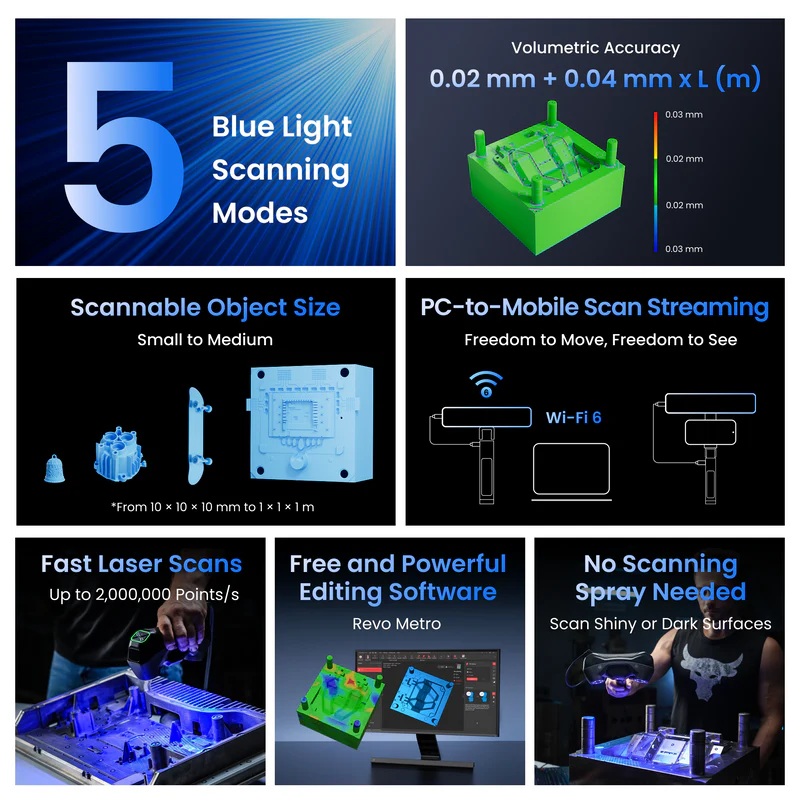
Innovations from companies like Revopoint have made high-quality scanning more accessible for creators of all levels. At Revopoint, users can explore handheld and portable scanners designed for precision, speed, and usability.
Key features of Revopoint scanners include:
- High-resolution scanning: Captures fine details for accurate models
- Portable handheld design: Ideal for studios, workshops, or field use
- Real-time tracking: Reduces scanning errors for smoother workflows
- Software compatibility: Works seamlessly with CAD software and 3D printers
These features make Revopoint scanners ideal for anyone looking to integrate a 3d printer scanner into their design or production workflow.
Tips for Getting the Best Results
To ensure the highest quality scans:
- Use proper lighting to reduce noise and improve detail capture.
- Keep objects stable during scanning to prevent distortion.
- Scan from multiple angles to capture all surfaces.
- Clean and optimize the mesh using software before exporting.
Following these practices ensures that digital models are accurate and ready for high-quality 3D printing.
Final Thoughts
3D scanning has become a crucial tool for makers, designers, and engineers in 2026. A 3d printer scanner allows users to capture real-world objects with precision, refine digital models, and produce accurate 3D prints efficiently.
By turning physical objects into digital designs, scanning workflows save time, reduce errors, and open new creative possibilities. Handheld scanners, like those from Revopoint, make this technology portable, reliable, and easy to use, bridging the gap between the physical and digital worlds.
For anyone working with 3D printing, integrating a 3d scanner for 3d printer into the workflow ensures faster, smarter, and more precise results, whether for professional projects, hobbyist creations, or educational purposes.